

South Carolina’s commercial property market continues to evolve as population growth, business investment, manufacturing activity, and expanding logistics networks influence demand across the state.
These forces are creating different conditions across industrial, office, retail, and commercial land, making it increasingly important for investors to look beyond broad market trends and understand what is happening at the property and submarket level.
Industrial real estate remains a major part of South Carolina’s growth story, supported by manufacturing and distribution activity, while population gains are contributing to demand for retail, services, and new development.
This year, office performance is more varied, with location and property quality playing an increasingly important role.
At the same time, infrastructure, including the Port of Charleston, Inland Port Greer, and the I-85 and I-26 corridors, continues to influence where businesses locate and where commercial development occurs.
In this article, we’ll share the trends shaping South Carolina commercial real estate, the opportunities and risks across major property types, and the factors investors should be watching, with additional insight into Greenville-Spartanburg, Seneca, the broader Upstate, and nearby Lavonia, Georgia.
What Is Shaping South Carolina’s Commercial Property Market?
South Carolina’s commercial real estate market is influenced by a combination of population growth, employment and business investment, manufacturing activity, and transportation infrastructure.
While these factors affect markets differently across the state, together they shape where businesses expand, where developers build, and where investors find opportunities.
Population and Employment Growth
South Carolina continues to add residents at a significant pace. The state’s population reached approximately 5.57 million in 2025, up from about 5.12 million in 2020—an increase of 8.8% in just over five years.
Greenville County’s 2025 population was about 583,125, an increase of 11% since 2020. Spartanburg County reached approximately 380,857 residents, representing growth of 16.1% over the same period.
Employment has also expanded. South Carolina added approximately 62,500 nonfarm jobs between May 2024 and May 2025, a 2.7% increase.
For commercial real estate, new residents and jobs create demand that extends well beyond housing. Growing communities need grocery stores, restaurants, medical offices, professional services, entertainment, warehouses, and other commercial properties.
For investors, however, the location of that growth matters as much as the statewide numbers. Population and employment gains concentrated around particular communities and transportation corridors can create very different conditions from one submarket to another.
Manufacturing and Corporate Investment
Business investment remains another major driver of South Carolina’s commercial property market. The state recorded $9.12 billion in announced capital investment during 2025, the third-highest annual total on record, along with more than 8,100 new jobs. More than 40% of both announced investment and new jobs were tied to rural communities.
South Carolina is home to more than 500 automotive companies, creating a network of manufacturers, suppliers, logistics providers, and related businesses statewide.
Recent investment in the Upstate shows how this activity can translate directly into commercial real estate demand. In 2025, Isuzu announced a $280 million investment in Greenville County, expected to create more than 700 jobs.
The company purchased a 1-million-square-foot facility on more than 200 acres in Piedmont for a new U.S. production base that can produce up to 50,000 vehicles annually.
Investment is also reaching smaller Upstate markets. Automotive supplier ElringKlinger announced a $68.5 million expansion in Pickens County in 2025, expected to create 294 jobs.
Projects like these can affect more than the properties occupied by the companies making the investment.
Large manufacturing operations can generate additional requirements for suppliers, warehouses, flex space, transportation providers, contractors, commercial land, and businesses serving a growing workforce. That makes major investment announcements worth watching when evaluating future commercial demand.
Logistics and Transportation Infrastructure
South Carolina’s logistics network helps connect its manufacturing and distribution base with markets across the Southeast and around the world.
The Port of Charleston handled approximately 2.6 million TEUs during fiscal year 2025, an increase of 3% from the previous year. The port also has a 52-foot-deep harbor, the deepest on the East Coast.
For the Upstate, Inland Port Greer provides a particularly important connection between the region’s industrial base and the Port of Charleston.
The facility handled a record 205,523 rail moves in fiscal year 2025, up nearly 10% year over year and the first time it exceeded 200,000 rail moves in a 12-month period. Its recent expansion also doubled cargo capacity and increased rail capabilities.
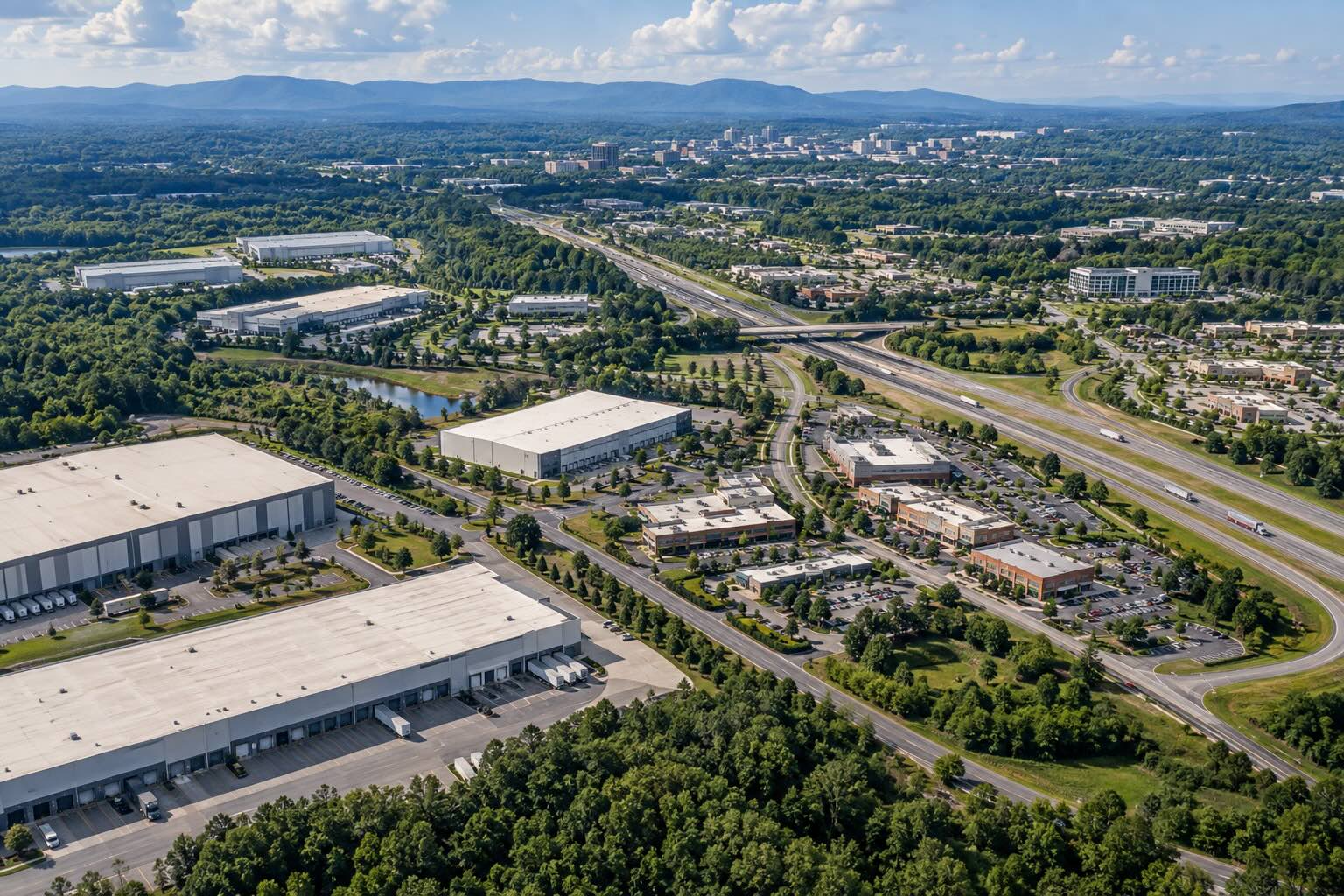
The interstate system adds another layer to that connectivity. I-85 runs through the Greenville-Spartanburg market and connects the Upstate with the Charlotte and Atlanta regions, while I-26 provides an important connection between the Upstate, Columbia, and the Charleston area.
When transportation access is combined with population growth, job creation, business investment, and sustained tenant demand, it can help explain why certain South Carolina and Upstate submarkets attract more commercial real estate activity.
Industrial Real Estate Continues to Drive the Market
Industrial real estate remains one of the most active segments of South Carolina’s commercial property market, particularly in the Upstate.
Manufacturing investment, logistics activity, and the region’s position along the I-85 corridor continue to support demand for warehouse, distribution, manufacturing, and flex space.
Strong Leasing and Absorption Are Tightening the Market
The Greenville-Spartanburg industrial market finished last year with significant tenant activity. Annual leasing activity reached approximately 12.6 million square feet, while net absorption exceeded 10 million square feet. By year-end, overall industrial vacancy had declined to about 9.2%.
Strong absorption means businesses are occupying that recently delivered space, gradually bringing supply and demand back into balance.
For investors, availability can vary considerably by building size, location, age, and property type. A large distribution facility may face a very different competitive environment than a smaller warehouse, flex building, or owner-user industrial property.
New Industrial Supply Is Slowing
The Greenville-Spartanburg industrial market is also working through a significant shift in new supply. After several years of heavy development, speculative construction slowed as recently delivered buildings were absorbed.
At the end of 2025, the market’s construction pipeline had fallen to approximately 1 million square feet, while about 3.4 million square feet of industrial space had been completed during the year.
By comparison, more than 41 million square feet had been delivered between the end of 2020 and the end of 2024.
That slowdown has continued to affect availability in 2026. In the first quarter, approximately 1.65 million square feet was under construction, compared with roughly 2.47 million square feet a year earlier.
By Q2 2026, another wave of development was taking shape, although developers were approaching new projects more cautiously than during the 2022–2024 construction cycle.
Statewide, speculative industrial construction had reached a low point after South Carolina’s industrial inventory expanded by nearly 25% over five years.
For investors, limited speculative construction can tighten availability if leasing remains strong, particularly for modern buildings.
At the same time, a new development cycle could add competition in certain submarkets, making it important to look at planned projects, building type, size, and location rather than relying on the overall market vacancy rate alone.
Large Distribution Facilities vs. Small-Bay Industrial
Much of the recent construction boom focused on large warehouse and distribution facilities, while smaller industrial buildings have generally seen less new supply.
Demand was strongest for bulk industrial space even as availability of those buildings became increasingly limited. At the same time, new speculative development was concentrating on 100,000- to 250,000-square-foot rear-load buildings and smaller 25,000- to 50,000-square-foot single-tenant properties.
In Q2 2025, rents were rising fastest for smaller shallow-bay properties, even while much of the market’s larger available inventory was still being absorbed. By Q2 2026, owner-user sales were also increasing as businesses competed to secure remaining industrial space.
For investors, this means an overall industrial vacancy rate should not be viewed as representative of every property. A 30,000-square-foot flex or warehouse building can face a very different competitive set than a 500,000-square-foot distribution center.
Industrial Investment Opportunities
In Q1 2026 alone, Greenville-Spartanburg recorded approximately 1.3 million square feet of net absorption, while demand was particularly strong for bulk industrial space even as available modern inventory became increasingly limited.
For investors, opportunities extend beyond large distribution centers. Smaller warehouses, flex properties, manufacturing facilities, owner-user buildings, and industrial land can benefit from the same manufacturing and logistics growth while operating within different supply conditions.
Properties with strong interstate access, modern loading configurations, adequate clear heights, and sufficient power capacity may be particularly important as tenant requirements become more specialized.
By Q2 2026, industrial activity was accelerating in Cherokee County, extending I-85 corridor growth farther northeast from Spartanburg toward Charlotte. Owner-user sales were also rising as companies sought to secure remaining industrial space rather than rely solely on the leasing market.
For investors evaluating industrial property, the opportunity therefore depends less on the broad “industrial” label and more on the individual asset.
Building size and condition, power availability, interstate and freight access, tenant demand, nearby industrial development, and the future construction pipeline should all factor into the investment decision.
South Carolina’s Office Market Is Increasingly Property-Specific
South Carolina’s office market is more nuanced than the industrial market, with performance varying considerably by location, building quality, and tenant profile.
Greenville-Spartanburg illustrates that divide well: overall office vacancy remains relatively low, but the strongest Class A properties operate under much tighter conditions than some suburban and older office buildings.
In Q1 2026, Greenville-Spartanburg’s overall office vacancy rate stood at 9.9%. By Q2, vacancy had declined to 9.2% after the market recorded more than 83,000 square feet of occupancy gains. That placed Greenville-Spartanburg among the 15 tightest office markets in the country.
Downtown Greenville’s Flight to Quality
Colliers reported that Class A vacancy in downtown Greenville was just 2.39% in Q1 2026, even as average asking rents for Class A space climbed above $40 per square foot for the first time.
The combination of limited availability and rising rents is also beginning to support new development. Colliers reported strong pre-leasing at the planned 101 East Court office project, with rents of about $50 per square foot.
If completed, the project would be the first new multi-tenant office development in Greenville’s central business district since Camperdown was completed in 2021.
Companies seeking modern, well-located office space have relatively few options in downtown Greenville, giving higher-quality properties greater pricing power even while other parts of the office market face more availability.
For investors, location, building quality, amenities, parking, tenant mix, and the availability of comparable space can significantly affect an office property’s performance.
Suburban Office Tells a Different Story
Outside downtown Greenville, office conditions vary significantly by submarket. In Q1 2026, vacancy stood at 12.4% in Southeast Greenville and 10.9% in Northeast Greenville, compared with just 2.1% in suburban Spartanburg, according to Cushman & Wakefield.
In Q2 2026, suburban Greenville-Spartanburg submarkets recorded 66,860 square feet of net absorption, with much of the activity coming from larger tenant commitments. The I-385/I-85 corridor remained particularly active for office leasing and sales.
Healthcare is contributing to that demand. Among the larger Q2 transactions was Piedmont Arthritis Clinic’s commitment to 22,480 square feet at Patewood III, while another 37,917 square feet was absorbed at 701 Millennium Boulevard.
Where Office Investment Opportunities May Exist
Differences in the Greenville-Spartanburg office market suggest investment opportunities are likely to be highly property-specific.
Rather than looking at office as a single category, investors may find stronger fundamentals in well-located Class A buildings, medical and professional office properties, smaller owner-user buildings, and properties that can be repositioned to meet current tenant expectations.
Healthcare is one area worth watching. In Q1 2026, Novant Health completed the purchase-leaseback of TD Bank’s approximately 295,000-square-foot campus, a transaction Colliers highlighted as evidence of continued healthcare demand in the market.
With Class A vacancy at only 2.39% in Q1 in Greenville and average asking rents above $40 per square foot, limited high-quality inventory may support existing well-positioned properties. However, investors also need to account for new development as higher rents begin to make office construction more feasible.
Spartanburg is seeing development as well. By Q2 2026, two office and mixed-use buildings were under development in the Spartanburg central business district, representing what Colliers described as the submarket’s most significant office construction in more than 10 years.
Retail Real Estate Remains Resilient as South Carolina Grows
Retail real estate has remained resilient across the Greenville-Spartanburg market, supported by population growth, new household formation, and limited additions to supply.
While national retailer closures have created vacancies in some older centers, much of that space is being backfilled as retailers expand into growing Upstate communities.
After absorbing approximately 83,400 square feet in Q2 2025, the Greenville-Spartanburg retail market recorded more than 120,000 square feet of net absorption in Q3, marking a second consecutive quarter of strong occupancy gains.
Colliers also reported retail rent growth of approximately 3%, while high-quality available space remained limited.
Population Growth Is Supporting Retail Demand
Much of that demand is following the Upstate’s expanding population. As discussed earlier, Greenville and Spartanburg counties have both experienced significant population growth since 2020, adding households that need grocery stores, restaurants, healthcare, fitness, personal services, and other neighborhood retail.
By Q3 2025, Colliers reported that grocery and home goods retailers remained in a growth phase across Greenville-Spartanburg, supported by favorable demographics and migration. Demand was also beginning to extend beyond the market’s traditional retail core as retailers followed residential growth into secondary corridors.
Older Retail Centers Are Finding New Uses
Older shopping centers are also creating opportunities for redevelopment and repositioning. In Q1 2025, several national retailer closures pushed Greenville-Spartanburg retail vacancy to 3.64% and resulted in 57,722 square feet of negative net absorption.
However, Colliers noted that three former Big Lots locations were quickly taken over by local or non-discount retailers, suggesting well-located larger spaces still attracted demand.
The market rebounded quickly. Net absorption reached 83,396 square feet in Q2, followed by more than 120,000 square feet in Q3. By Q3, Colliers reported that older shopping centers were being backfilled at a healthy pace as retailers expanded into available space.
Much of the remaining vacancy has been concentrated in older properties, leading some owners to invest in improvements to attract stronger tenants.
Colliers also found that renovated retail properties were achieving significantly higher rents than lower-quality space, creating potential value-add opportunities for investors willing to improve an aging center.
Retail Investment Opportunities
With retail vacancy remaining relatively low and available space being absorbed, opportunities in the Upstate are increasingly tied to location, tenant demand, and the growth of individual corridors rather than the retail market as a whole.
Neighborhood and service-oriented retail can be particularly relevant in areas experiencing residential growth. Grocery stores, restaurants, healthcare providers, fitness businesses, and other service tenants depend heavily on nearby households, making population growth an important factor when evaluating these properties.
Greenville-Spartanburg recorded more than 120,000 square feet of net retail absorption in Q3 2025, while rents were approximately 3% higher year over year, according to Colliers. Limited high-quality availability and continued tenant demand can create opportunities to renovate or reposition older centers in strong locations.
For investors looking beyond established retail districts, emerging corridors may offer another path. Areas adding housing, employers, and infrastructure can generate demand for neighborhood retail before they develop into mature commercial centers.
Greenville, Greer, Spartanburg, Easley, and other growing Upstate communities are therefore worth evaluating at the corridor level rather than relying solely on broader market averages.
Regardless of location, investors should consider surrounding population growth, household income, traffic counts, visibility, access, tenant mix, lease terms, nearby residential development, and competing retail supply before acquiring a property.
Commercial Land and Development Opportunities Are Following Growth
Population growth and business investment are also influencing demand for commercial and industrial land across South Carolina.
In the Upstate, new manufacturing facilities, expanding employers, residential development, and infrastructure improvements are creating demand for sites that can support industrial, retail, service, and other commercial uses.
Where Development Demand Is Expanding
Recent projects illustrate the scale of development occurring across the Upstate. In Greenville County, Isuzu purchased a 1-million-square-foot facility on more than 200 acres in Piedmont for its new U.S. production base. The company plans to invest $280 million and create more than 700 jobs.
Spartanburg County is also seeing additional development. Woodward announced plans in 2025 for a nearly $200 million investment and a new 300,000-square-foot manufacturing facility at Smith Farms Industrial Park in Greer, creating approximately 275 jobs.
These projects build on larger investments already reshaping the Upstate. BMW’s $1.7 billion expansion includes $1 billion for electric-vehicle production at Plant Spartanburg and another $700 million for a battery assembly facility in Woodruff. The Woodruff facility encompasses more than 1 million square feet and is expected to create 300 jobs.
Development is not limited to Greenville and Spartanburg. Recent economic development activity has also included new and expanding manufacturing, distribution, and technology projects in Anderson, Pickens, Cherokee, Oconee, and other Upstate counties.
For commercial property investors, that makes it important to follow where employment and residential growth are occurring because those investments can generate additional demand for industrial sites, retail, services, and other commercial development.
What Makes Commercial Land Attractive—or Risky
Two parcels within the same growth corridor can have very different development potential depending on zoning, entitlements, water and sewer availability, electrical capacity, road access, topography, environmental conditions, and the cost of site preparation.
Utilities are becoming particularly important for industrial development. Large manufacturing and technology projects can have substantial power requirements, making electrical capacity and the timeline for utility improvements an increasingly important part of site selection.
Investors should also consider what is happening around a property. New subdivisions, major employers, road improvements, industrial parks, and other development can change the long-term demand for a site.
At the same time, purchasing land based solely on projected growth can create risk if infrastructure, zoning, or utilities do not support the intended use.
For that reason, commercial land should be evaluated not simply by acreage or price per acre, but by what can realistically be developed on the property, how quickly it can be developed, and what demand exists for that use.
South Carolina’s Major Commercial Property Markets
South Carolina’s major commercial real estate markets are being influenced by many of the same statewide trends, but the mix of demand differs considerably by region.
Greenville-Spartanburg is heavily influenced by manufacturing and the I-85 corridor, Charleston benefits from its port and coastal growth, while Columbia combines government, education, healthcare, and manufacturing demand.
Greenville-Spartanburg
Greenville-Spartanburg remains one of South Carolina’s most active industrial and manufacturing markets. Industrial properties recorded approximately 1.3 million square feet of net absorption in Q1 2026, with particularly strong demand for bulk space and increasingly limited availability of modern buildings.
Office fundamentals have also remained strong in select locations. In Q2 2026, suburban office submarkets recorded 66,860 square feet of net absorption, while downtown Greenville continued to face limited Class A availability and rising rents.
The combination of manufacturing, logistics, population growth, and expanding employment makes Greenville-Spartanburg a diverse commercial property market rather than simply an industrial hub. Conditions can still vary considerably between downtown Greenville, the I-85 corridor, Spartanburg, Greer, and surrounding communities.
Charleston
Charleston’s commercial property market has different demand drivers, including the Port of Charleston, manufacturing, tourism, population growth, and continued expansion into surrounding communities.
Industrial conditions improved significantly during the first half of 2026. Charleston recorded approximately 1.03 million square feet of industrial absorption in Q2 alone, bringing year-to-date absorption to more than 3.46 million square feet.
Industrial vacancy declined 362 basis points from the end of 2025 as the market worked through the previous wave of new supply.
Charleston’s office market has also shown strong demand for higher-quality space. By Q2 2026, Class A office tenants on the Charleston Peninsula were regularly paying more than $50 per square foot, while rents for some newer space exceeded $60 per square foot.
Those conditions illustrate why Charleston needs to be viewed differently from the Upstate: port activity, coastal population growth, land constraints, and high development costs all influence commercial property decisions.
Columbia
Columbia benefits from its central location in South Carolina, as well as demand from state government, healthcare, higher education, distribution, and manufacturing.
The market also demonstrates how property quality can matter as much as overall availability. In Q2 2026, downtown Columbia Class A office vacancy was just 2.61%, while vacancy among Class C properties was approximately four times higher.
A similar divide exists in industrial real estate. The average vacant industrial property in Columbia was built in 1982, while six of the market’s seven available buildings larger than 150,000 square feet dated to the 1960s.
Modern Class A industrial availability remained limited, particularly for companies requiring higher clear heights and substantial power capacity.
Other Upstate Growth Markets
Commercial activity in the Upstate extends beyond Greenville and Spartanburg.
Anderson, Pickens, Cherokee, and Oconee counties are attracting manufacturing and distribution investment that can create additional demand for industrial properties, commercial land, retail, and supporting services.
- Anderson County: Manufacturing and distribution investment continues to expand the county’s industrial base. In 2025, Eastern Engineered Wood Products announced an $18.7 million investment for its first South Carolina operation, while Southern Wall Products announced a $23 million investment. Anderson’s position along I-85 also provides access to Greenville-Spartanburg and the broader Atlanta-Charlotte corridor.
- Pickens County: Advanced manufacturing is creating new commercial activity around Easley and other parts of the county. Automotive supplier ElringKlinger announced a $68.5 million expansion and 294 new jobs in 2025, bringing its combined investment in Pickens County to approximately $135 million. Investments of this scale can create additional demand from suppliers, service businesses, and other supporting commercial uses.
- Cherokee County: Industrial growth is extending farther northeast along I-85 toward the Charlotte region. Aerowerks announced a $10 million investment and 52 new jobs for its first U.S. manufacturing operation in Gaffney. Cherokee County’s interstate access and location between Spartanburg and Charlotte make it another Upstate industrial market worth watching.
- Oconee County and Seneca: Manufacturing investment is also reaching the western Upstate. Baxter Manufacturing announced a $15.7 million expansion and 36 new jobs in Westminster in 2025, while Ulbrich Specialty Wire Products announced another $5 million expansion. Continued investment around Oconee County and Seneca can support demand for industrial space, commercial land, and businesses serving local employers and residents.
For investors, these secondary Upstate markets can offer a different opportunity than Greenville-Spartanburg. Population growth, major employers, transportation access, and planned development should therefore be evaluated at the individual market and property level.
What Commercial Property Investors Should Watch in 2026 and Beyond
South Carolina’s underlying growth can support commercial real estate demand, but broader economic and property-market conditions will continue to influence individual investments.
Interest Rates and Financing Costs
In September 2026, the Federal Reserve set the target range for the federal funds rate at 3.75% to 4.00%, meaning borrowing costs remain an important part of acquisition and development decisions.
Credit conditions have shown signs of improving. In the Federal Reserve’s July 2026 Senior Loan Officer Opinion Survey, banks reported generally easier lending standards for commercial real estate loans during the second quarter.
However, banks also indicated that CRE lending standards remained toward the tighter end of their historical ranges, particularly for construction and land development loans.
For investors, financing costs can materially change whether a property works at a particular purchase price. Higher debt costs reduce cash flow and can make development harder to justify, while improving credit conditions can support more transaction activity.
Rather than evaluating a property based only on its asking price or projected cap rate, investors should consider debt cost and availability, required equity, loan terms, refinancing risk, and how the investment would perform if borrowing costs change.
New Construction and Development Pipelines
South Carolina’s industrial inventory expanded by nearly 25% over five years leading into Q2 2026. After that significant wave of development, speculative construction slowed sharply.
By Q2 2026, statewide speculative construction had effectively reached a low point, although new development cycles were beginning to emerge in Greenville-Spartanburg and Columbia.
Greenville-Spartanburg illustrates how quickly the supply picture can change. At the end of 2025, the industrial construction pipeline had fallen to only about 1 million square feet, compared with approximately 3.4 million square feet of space completed during 2025.
By Q2 2026, however, another development wave was beginning to take shape as available modern industrial space tightened.
Limited construction can support occupancy and rents in supply-constrained locations, while a large pipeline can create additional competition for tenants. Investors should therefore examine planned development within the individual submarket rather than relying solely on today’s vacancy rate.
Construction and Replacement Costs
Turner Construction’s national Building Cost Index increased 5.15% year over year in Q2 2026 and 1.44% from the previous quarter. Turner noted particularly strong construction demand from advanced manufacturing and other high-growth sectors, including activity in the Southeast.
Higher construction costs can make new development more difficult to justify, particularly when rents do not support the cost of building new space. They can also affect the value of existing properties by increasing the cost of building a competing property.
This is particularly important for industrial properties, where modern tenants may require higher clear heights, greater power capacity, improved loading configurations, and other features that can be expensive—or impractical—to add to an older building.
Vacancy, Absorption and Rent Growth
Absorption shows whether tenants are actually taking more or less space, while rent trends help indicate whether demand is translating into greater pricing power for property owners.
The Greenville-Spartanburg market demonstrates why these figures need to be considered together. Industrial vacancy finished 2025 at approximately 9.2%, but the market also recorded more than 10 million square feet of annual net absorption.
Leasing remained strong into 2026, with nearly 2.9 million square feet of industrial leases signed in Q2 and almost 7 million square feet leased during the first half of the year.
Greenville-Spartanburg office vacancy declined to 9.2% in Q2 2026 after the market recorded more than 83,000 square feet of occupancy gains. Yet downtown Greenville Class A space has operated under much tighter conditions than the broader market, demonstrating why property quality and submarket matter.
Greenville-Spartanburg recorded more than 120,000 square feet of net retail absorption in Q3 2025, while rents increased approximately 3% and high-quality availability remained limited.
South Carolina Commercial Real Estate Outlook
South Carolina’s commercial property market continues to benefit from population growth, business investment, manufacturing activity, and an expanding logistics network, but the opportunities are becoming increasingly specific to property type and location.
Industrial demand remains a major part of the state’s commercial real estate story, particularly across the Upstate and I-85 corridor. Retail continues to benefit from household growth and expansion into developing communities, while office performance increasingly depends on building quality, location, and tenant demand.
Commercial land presents opportunities as well, but infrastructure, utilities, zoning, and development costs can significantly affect the viability of individual sites.
For investors, the key is to look beyond statewide trends. Vacancy, absorption, new construction, financing costs, major employer investments, and population growth all need to be considered at the individual property and submarket level.
Whether you’re looking for industrial space, office or retail property, commercial land, or an investment opportunity, Upstate Commercial Hub can help you explore available commercial properties throughout the region.
Browse commercial properties in Greenville-Spartanburg, Seneca, the surrounding Upstate, and nearby Lavonia, Georgia, or contact us to discuss your property requirements and investment goals.